
One anxiety case, 8 different approaches: what each school sees and what multidimensional analysis reveals

Patricio Espinoza
February 20, 2026
One anxiety case, 8 different approaches: what each psychological school sees and what multidimensional analysis reveals
According to data from the Global Burden of Disease Study 2021, 359 million people worldwide live with an anxiety disorder, making these the most prevalent of all mental health conditions (World Health Organization [WHO], 2025). The age-standardized global prevalence reaches 4.4%, with an 18% increase since 1990 (Li et al., 2025). The COVID-19 pandemic made things worse: a study published in The Lancet estimated a 26% increase in anxiety disorders globally in 2020 alone (Santomauro et al., 2021).
But there is one finding that should trouble any psychologist: a recent meta-analysis of placebo-controlled trials found that CBT effect sizes for anxiety disorders have declined in recent years, with a Hedges' g of just 0.24 in studies published since 2017 (Bhattacharya et al., 2023). Half of patients do not improve enough with first-line treatment. Not because the techniques are bad. But because anxiety operates across more dimensions than any single approach can cover.
What you are about to read is not theory. We are going to take a concrete clinical case (a 38-year-old woman with generalized anxiety, a history of early trauma, and a family system that perpetuates the problem) and run it through 8 different offices. You will see what a CBT therapist, a Gestalt therapist, a systemic therapist, a Jungian analyst, and four others would do. Then, you will see what happens when that same case enters Omnia and all 12 dimensions are analyzed simultaneously. With real screenshots. With the platform's actual text responses. In real time.
The goal is not to prove your approach is wrong. It is to show you what you might be missing.
Meet Mariana
Mariana is 38 years old. She is an accountant who has worked at the same company for 12 years. She is married and has two children, ages 6 and 9. She comes to therapy referred by her general practitioner, after the cardiologist ruled out any cardiac cause for her tachycardia.
In her own words: "I have been feeling for 8 months like something bad is about to happen. I wake up at 3 or 4 in the morning with my heart racing and I cannot fall back asleep. At work I have trouble concentrating, I check everything three times. My husband says I am unbearable, that everything bothers me. I already went to the cardiologist and he said there is nothing wrong. The GP prescribed alprazolam but I do not want to depend on pills."
The symptoms began shortly after her mother was diagnosed with breast cancer. Mariana describes that from that moment "something broke." Before, she considered herself a strong person, someone who can handle everything. Now she reports unexpected crying episodes, constant muscle tension in her neck and jaw (she was diagnosed with nocturnal bruxism), irritable bowel syndrome that worsened significantly, and a persistent sense of unreality: "sometimes I feel like I am watching my life from the outside."
Her childhood history has layers. Functional alcoholic father. Emotionally distant mother, "always working to make up for what my dad did not provide." From the age of 7, Mariana took on the role of caring for her younger brother when her father came home drunk. She was the top student in her class. First in her family to earn a college degree. At 23, she had a severe panic episode that she resolved "alone, without professional help, through sheer willpower."
Her marriage has been strained for two years. She feels she carries the household and children alone. She describes her husband as "a good person but emotionally absent, like my mom." And a detail that no clinician would miss: her older son has started showing anxious behaviors at school, not wanting to separate from her in the mornings. Meta-analyses on the intergenerational transmission of anxiety confirm significant associations between parental anxiety symptoms and children's emotional problems (Trepiak et al., 2022; Bie et al., 2024).
She sleeps 4 to 5 hours. Drinks a lot of coffee. Does not exercise. Uses alprazolam sporadically when she "cannot take it anymore."
This is the case. What would you do?
The same case, 8 different offices
Each psychological school has a particular lens. That lens illuminates certain aspects of the case with extraordinary precision. But it also has blind spots. Not due to deficiency, but by design. Let us walk through the 8 offices and see what each one would find.
The cognitive-behavioral therapy office
A CBT therapist would listen to Mariana and quickly identify a pattern of catastrophic automatic thoughts. According to Beck's (1976) cognitive model, anxiety is maintained through cognitive distortions that amplify the perception of threat and underestimate coping resources. "Something bad is going to happen" is a classic anxious anticipation. The need to check everything three times is a verification behavior that, as Clark and Beck (2010) point out, maintains the anxiety cycle by preventing habituation to uncertainty.
The therapist would map the cognitive distortions: catastrophizing (anticipating the worst), all-or-nothing thinking (being "the strong one" or being "broken"), personalization (assuming all responsibility for the household). They would identify intermediate beliefs ("If I do not control everything, something terrible will happen") and begin tracking core beliefs: "I am only valuable if I am perfect and strong," "The world is dangerous." Young et al.'s (2003) schema model would deepen these patterns as early maladaptive schemas rooted in childhood experiences of emotional deprivation and unrelenting standards.
The plan would include automatic thought records, cognitive restructuring, gradual exposure to uncertainty (stopping the triple-checking), and relaxation techniques for insomnia. It is a solid approach, with the most extensive evidence base of all psychotherapies. A network meta-analysis that included 52 clinical trials with 4,361 patients with GAD confirmed the superiority of individual CBT over waitlist (standardized mean difference of 1.62) and over treatment as usual (Yin et al., 2025).
Which dimensions does CBT address here? Fundamentally the cognitive dimension (D7 in the Omnia model): beliefs, schemas, distortions. And partially the behavioral and physiological dimensions through relaxation techniques.
What falls outside its field of vision? The abandonment wound from age 7. The transgenerational repetition of the caregiver role. The contained rage beneath the anxiety. The symbolic meaning of "something broke" when her mother got sick. The personality structure that makes it impossible for Mariana to let go of control. The archetypal dream she will have 6 weeks later. The transmission of anxiety to her son. Not because CBT denies these dimensions. They are simply not its focus of intervention.
The REBT office
A Rational Emotive Behavior Therapy practitioner would go straight to the system of irrational beliefs. REBT, developed by Albert Ellis (1962), shares territory with CBT but has a sharper philosophical edge. It does not just identify dysfunctional cognitions; it actively disputes the absolutist demands that sustain them. As David et al. (2018) note in their review of the empirical evidence, irrational beliefs are rigid, illogical, and inconsistent with reality, and they underpin dysfunctional negative emotions.
In Mariana's case, REBT would detect several central irrational demands: "I must be able to control everything" (demand on self), "My husband should know what I need without me telling him" (demand on others), "Life should not be this unfair" (demand on the world). These demands, according to Ellis's ABC model, generate emotional disturbance because they clash with reality.
The REBT therapist would use active disputation: "Where is the evidence that you must be able to control everything? What law of the universe says your husband must read your mind?" The goal is to move Mariana from absolute demands to flexible preferences. A recent systematic review that identified 162 REBT intervention studies confirmed its effectiveness across multiple contexts, with significant reductions in irrational beliefs and improvements in mental health (King et al., 2024).
It is powerful work on the cognitive dimension, with greater philosophical depth than standard CBT. But it shares similar limitations: it does not address deep somatization, systemic dynamics, the attachment wound, or the character structure that converts anger into perfectionism.
The Gestalt office
A Gestalt therapist would perceive something that CBT and REBT would likely overlook in the first sessions: Mariana's body is speaking. The neck tension, the clenched jaw, the irritable bowel, the tachycardia: all of this is interrupted experience, emotion that never found its way out. From Perls et al.'s (1951) perspective, somatic symptoms represent contact with the environment that has become rigid, losing spontaneity and flow.
The Gestalt therapist would work in the here and now. "What do you feel right now as you tell me this? Where do you feel it in your body?" They would explore the experience cycle and where it gets interrupted: Mariana feels the emotion (sensation phase), but before it reaches full awareness and action, she blocks it. Retroflection is her primary mechanism: she directs against herself (tension, bruxism, somatization) the energy that should go outward (anger, the need to set boundaries).
The empty chair would be a natural intervention: placing her mother in the imaginary chair and allowing what was never said to emerge. "Mom, I needed you to be there and you were not." That sentence could open an emotional floodgate that has been sealed for decades. A recent study with 319 patients with mood or anxiety disorders demonstrated statistically significant differences in anxiety (t = 16.46; p < 0.0001) and depression (t = 11.24; p < 0.0001) after a Gestalt therapy program (Calvet et al., 2025). And a multiple case study at the University of Vienna documented significant improvements in patients with anxiety disorders, PTSD, and depression treated with integrative Gestalt therapy (Kaisler et al., 2023).
Gestalt brilliantly illuminates the emotional dimension (D6) and the body-emotion connection (D1-3). It sees what CBT does not look at: lived experience, not just interpreted experience. But it has its own blind spots. It does not map personality structure with the specificity of the Enneagram. It does not work with the transgenerational family system with the depth of systemic therapy. And its focus on the present can leave unexplored the timeline that connects the 7-year-old girl with the 38-year-old woman sitting in front of it.
The systemic therapy office
A systemic therapist would see something that none of the previous ones would prioritize: Mariana is not just an individual patient. She is a node in a family system that repeats itself. Bowen's (1978) family systems theory posits that family members are interdependent and that one member's well-being has a significant impact on the others, a principle that research on the intergenerational transmission of trauma has empirically confirmed (Narayan et al., 2022).
The genogram would reveal a disturbing transgenerational pattern. In her family of origin: absent father (alcoholic), overburdened and emotionally unavailable mother, Mariana as the parentified daughter who cares for the younger brother. In her current family: emotionally absent husband, her overburdened with household and children, and her older son beginning to show separation anxiety. The system copies itself with frightening precision. As Calatrava et al. (2022) note in their review of Bowen's concept of differentiation of self, individuals with low differentiation tend to replicate the relational patterns of their family of origin.
The systemic therapist would identify rigid roles, relational triangles (Mariana-husband-children replicating Mariana-mother-brother), and invisible loyalties. From Minuchin's (1974) perspective, diffuse boundaries between family subsystems perpetuate dysfunction. Her mother's illness triggered a systemic alarm: the figure that justified Mariana's sacrifice ("I endure everything because she needs me") is now at risk of disappearing. Without that systemic function, the entire scaffolding collapses.
Systemic therapy sees relational architecture with a clarity that no individual approach matches. Von Sydow (2024) offers an updated synthesis of its theoretical and practical foundations. But it has an important blind spot: it tends to underestimate the individual intrapsychic experience. Mariana's personality structure, her specific defense mechanisms, her relationship with the unconscious, her crisis of existential meaning: all of this takes a back seat when the focus is on the system.
The Jungian office
A Jungian analyst would listen to Mariana and pay special attention to a detail that the other offices might register as anecdotal: the depersonalization. "I feel like I am watching my life from the outside" is not just a dissociative symptom. From Jung's (1968) perspective, it can be an invitation from the unconscious to see life with different eyes, to question the identification with the Persona (the mask of "the strong one, the perfect one").
The Jungian would explore Mariana's Shadow: everything she has repressed to maintain her image of strength. Vulnerability, the need to be cared for, anger, imperfection. They would also analyze the archetypes at work: Mariana is trapped in the Great Mother archetype: she cares for everyone but no one cares for her. Her individuation, the central process of Jungian psychology (Stein, 2006), requires that she integrate the Shadow and free herself from identification with that role.
And the dream. When Mariana reports, weeks later, a recurring dream where she searches for someone in a dark house without finding them, the Jungian would have privileged material. The dark house as a representation of the familial unconscious. The person who cannot be found as the nurturing mother she never had, or the version of herself free from the burden of duty. Jung (1964) held that dreams compensate for the one-sidedness of the conscious attitude and provide essential material for the therapeutic process.
The Jungian approach illuminates the unconscious and archetypal dimensions (D10) and the deep emotional dimension (D6) with a symbolic richness that no other approach achieves. But it can neglect the urgent: the body in crisis (4 hours of sleep, tachycardia), the immediate cognitive intervention, and the systemic work with the couple.
The logotherapy office
A logotherapist in the tradition of Viktor Frankl would listen to Mariana's case and detect something that the previous approaches barely touch: a crisis of meaning. Beneath the anxiety, beneath the insomnia and tachycardia, there is an existential question that Mariana does not know she is asking herself: "Who am I when I am not taking care of everyone else?"
Her entire identity was built on being useful, responsible, strong. The top student. The first college graduate in the family. The one who cares for the brother. The one who carries the household. Frankl (1946/2006) argued that the primary motivational force in human beings is the search for meaning, and that when this search is blocked, what he called an "existential vacuum" emerges, a state that can manifest as anxiety, depression, or addiction. Her mother's illness did not just trigger a fear of loss. It shook the foundations of her life's purpose.
Logotherapy would work with self-transcendence: helping Mariana find values and meaning beyond her roles of service. Dereflection, one of logotherapy's three main techniques, would help her stop obsessively monitoring herself (checking symptoms, anticipating catastrophes) and redirect attention toward something meaningful outside herself. A meta-analysis by Diadiningrum and Yudiarso (2022) confirmed logotherapy's effectiveness on psychological variables such as self-esteem, hope, and meaning in life, though with the caveat that more methodologically rigorous studies are needed.
Logotherapy illuminates the existential dimension (D9) with a depth that no other approach offers. But it does not work on somatization, character structure, or the family system. And it may arrive at the question of meaning too soon when the nervous system is still in survival mode.
The psychoanalytic office
A psychoanalyst would listen to Mariana with free-floating attention and begin tracing the lines of transference from the first session. How does Mariana relate to the therapist? Probably with the same mix of distrust and need that characterizes all her attachment figures: she wants help but cannot allow herself to depend.
Psychoanalysis would identify the defense mechanisms at work. Freud (1926/1959) described anxiety as a signal from the ego upon perceiving danger, and defense mechanisms as strategies to manage that signal. In Mariana, three mechanisms would be evident: reaction formation (converting rage into over-responsibility), rationalization ("I had a normal childhood, like everyone else"), and sublimation that overflowed (channeling anguish into achievement until the mechanism was no longer enough). Repetition compulsion, a central concept in Freudian psychoanalysis, would be apparent: Mariana married someone emotionally absent like her mother because her psyche seeks to recreate the original wound with the unconscious hope of resolving it.
The work would be slow, deep, relational. Exploring the transference, making the unconscious conscious, working through resistance when Mariana tries to be "the perfect patient." From attachment theory, which has roots in both psychoanalysis and developmental psychology, Bowlby (1969/1982) proposed that internal working models formed in childhood determine adult relational patterns, a principle that contemporary research has extensively validated (Mikulincer & Shaver, 2019).
But it has practical limitations: the time (years of analysis), the absence of direct body intervention for a nervous system in crisis, and a certain reluctance to incorporate active emotional regulation tools that Mariana needs now, not in six months.
The humanistic office
A humanistic therapist, in the tradition of Rogers (1961), would offer Mariana something she may have never experienced: unconditional positive regard. A space where she does not have to be strong, perfect, or productive. Where she can cry without feeling "broken" and express anger without fear of judgment.
The humanistic therapist would see a profound incongruence between Mariana's real self (exhausted, frightened, needy) and her self-concept (strong, capable, someone who endures everything). Rogers (1959) posited that this gap between the organism and the self-concept generates anxiety. The actualizing tendency, the natural drive toward growth, is blocked because Mariana introjected conditions of worth from childhood: "I am only acceptable if I am perfect and do not cause problems." Recent research on the effectiveness of humanistic-experiential therapies shows outcomes comparable to CBT for various disorders, particularly when the therapeutic alliance is measured as a factor of change (Elliott et al., 2021).
The humanistic approach illuminates the emotional dimension and partially the existential one. Its power lies in the therapeutic relationship as an agent of change. But it shares with logotherapy the limitation of not intervening directly on the body in crisis, and with psychoanalysis the limitation of not working the systemic dimension with specific tools.
The pattern that emerges
If you place these 8 offices side by side, the pattern is clear. Each approach sees something real and valuable. None of them sees everything.
CBT sees the thoughts (Beck, 1976). REBT sees the irrational beliefs (Ellis, 1962). Gestalt sees the body and the emotion (Perls et al., 1951). Systemic therapy sees the relationships and family patterns (Bowen, 1978). Jungian analysis sees the unconscious and the symbolic (Jung, 1968). Logotherapy sees meaning (Frankl, 1946/2006). Psychoanalysis sees the defense mechanisms and the repetition (Freud, 1926/1959). Humanistic therapy sees the incongruence between the real and ideal self (Rogers, 1961).
But Mariana's anxiety operates simultaneously across all those dimensions. And also across others that none of these 8 offices specifically addresses: the neurobiology of insomnia, the Enneagram character structure (Naranjo, 1994; Riso & Hudson, 1999), the transpersonal dimension, the broader systemic consciousness.
What happens when you look at all 12 dimensions at the same time?
The case enters Omnia: analysis in real time
What follows is neither theory nor simulation. It is exactly what happens when a psychologist enters Mariana's case into Omnia and requests a multidimensional analysis. The responses you are about to read are the ones the platform generated. The screenshots are real.
How it works
The process is deliberately simple. You create a patient on the platform, describe the case in natural language (as you would tell the case to a supervisor), and Omnia returns an analysis that crosses all 12 dimensions of the human being: physical/neurobiological, temporal/biographical, psychopharmacological, emotional/affective, cognitive/mental, personality/character, existential/meaning, unconscious/archetypes, transpersonal, and consciousness/systemic.
You do not need to know the 12 dimensions beforehand. You do not need to formulate the case in specific technical language. You describe what you see in your office, and the platform returns what you might be missing.
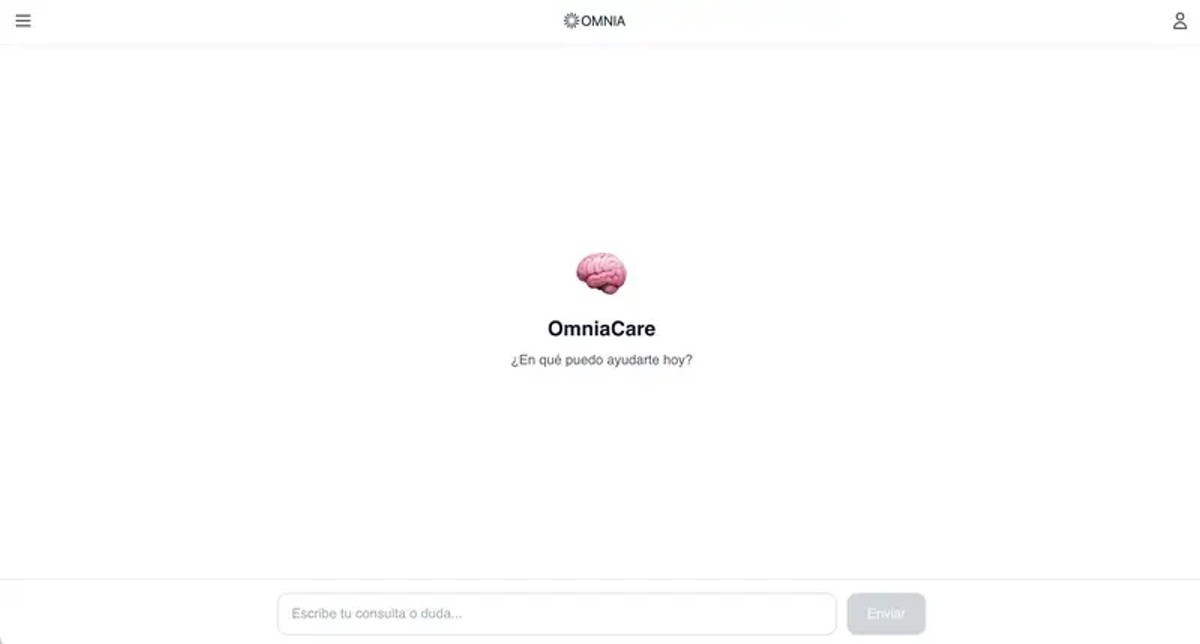
Initial consultation: the complete case in a single view
Mariana's complete clinical history was entered exactly as presented above: presenting complaint, symptoms, background, family situation, current treatment. A description in natural language, the kind any psychologist would write in their first-session notes.
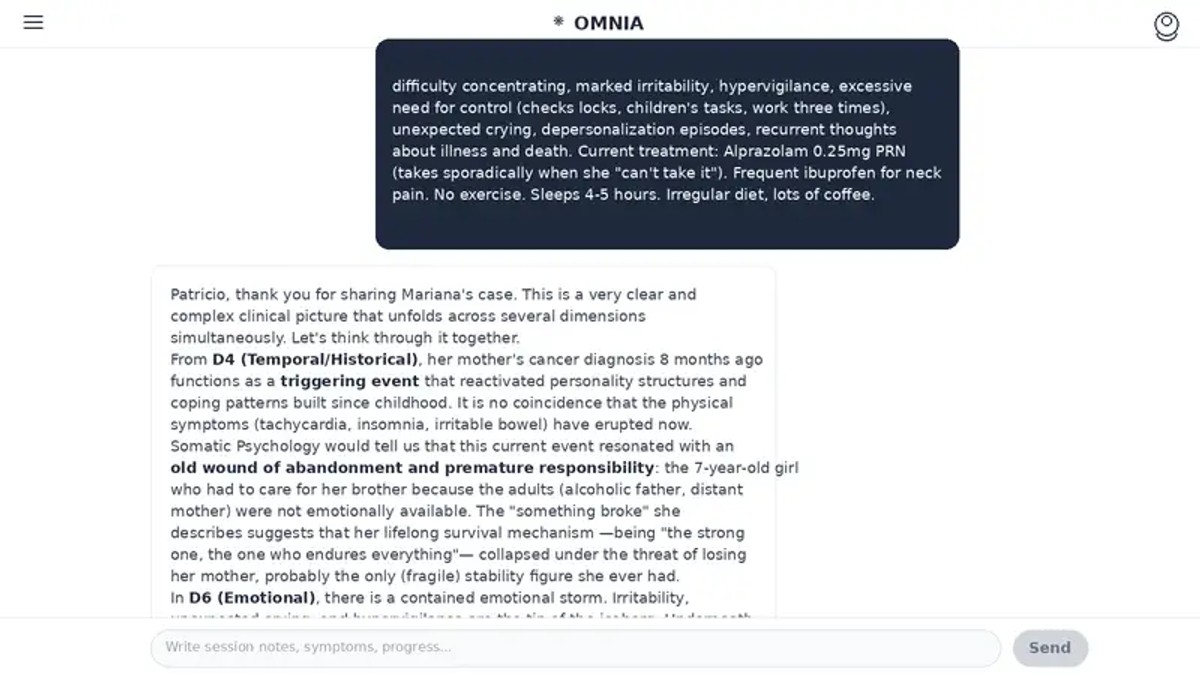
Omnia's response started where no single approach would start: connecting dimensions simultaneously.
From the temporal/historical dimension (D4), Omnia identified the mother's cancer diagnosis as a triggering event that reactivated a structure built in childhood. Not as an isolated trigger, but as a biographical resonance: the current event connects with the abandonment wound and premature responsibility of the 7-year-old girl who cared for her brother because the adults were unavailable. This type of reactivation is consistent with research on adverse childhood experiences (ACEs), which demonstrates how early experiences determine later relational quality and can increase family dysfunction through the intergenerational transmission of trauma (Narayan et al., 2022). The "something broke" that Mariana describes is the collapse of her survival mechanism when faced with the threat of losing the only stability figure she ever had.
In the emotional dimension (D6), it detected what it called a "contained emotional storm." Irritability, unexpected crying, and hypervigilance are the visible surface. Underneath lies primary fear of loss, rage at feeling alone and overburdened, and a deep sadness for the girl who was never cared for. The depersonalization ("watching my life from the outside") was analyzed as a dissociative mechanism in response to overwhelming emotions: the nervous system, saturated, disconnects to survive. This is consistent with research on fearful-avoidant attachment, which shows that individuals with this pattern exhibit depression and anxiety levels 5% to 6% higher than those with secure attachment (Scharfe et al., 2023).
The personality dimension (D8) produced one of the most revealing readings. Without a formal test, based exclusively on the clinical history, Omnia proposed a hypothesis of Enneagram Type 1 (The Reformer) with a 9 wing. The reasoning was detailed: perfectionism ("top student"), rigidity ("checks everything three times"), sense of duty (caring for the brother, carrying the household), repressed anger manifesting as irritability and muscle tension. Riso and Hudson (1999) describe Type 1 as motivated by the need to be good, correct, and virtuous, with a conflicted relationship with anger: the dominant passion of the One is precisely anger, not explosive but resentful and contained, freezing in the body. Naranjo (1994) identified this structure as "angry perfectionism," where reaction formation converts rage into self-demand. Research on the relationship between Enneagram typologies and psychosocial stress has found significant associations between certain types and coping patterns, although the field requires further empirical validation (Ramos-Vera et al., 2022).
In the physical dimension (D1-3), the analysis was direct: the body is screaming. Insomnia between 3 and 4 AM reflects the activation of the alarm system. Tachycardia, worsened irritable bowel, and bruxism are the somatic expression of chronic anxiety and early trauma. The WHO (2025) recognizes that anxiety and physical tension are closely related, and that many of the impacts of anxiety (such as muscle tension and nervous system hyperactivity) are also risk factors for cardiovascular disease.
And from the existential dimension (D9), Omnia detected the question that Mariana has not yet consciously formulated: "Who am I when I am not taking care of others or fulfilling duties?" Her identity was built on doing, not being. What Frankl (1946/2006) called "existential vacuum" when the habitual sources of meaning collapse.
What it did differently: In a single consultation, Omnia crossed 5 dimensions that, working with a single therapeutic approach, could take weeks or months to map. Not because it replaces clinical judgment, but because it widens the field of vision from the very first moment.
Deepening: attachment, personality, and the family system
Omnia was asked to go deeper into three specific dimensions: emotional, personality, and systemic. The questions were direct: What attachment patterns are identified? What defense mechanisms are operating? What systemic role is she repeating in her current family relative to her family of origin?
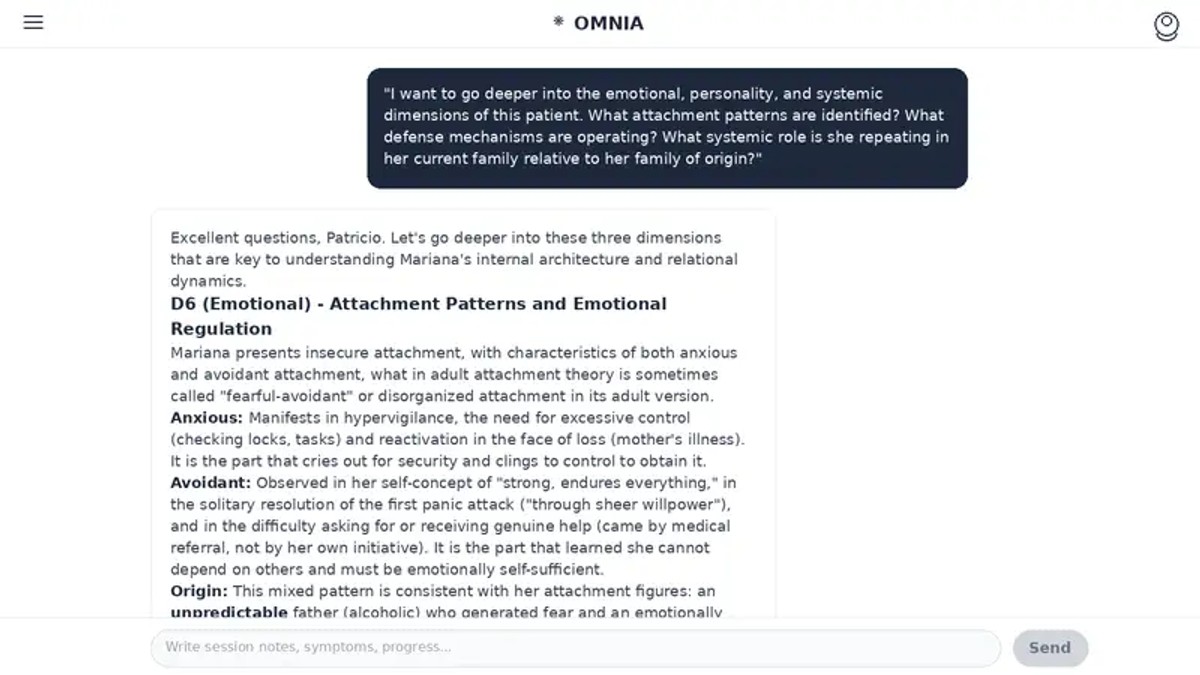
The attachment analysis was precise. Omnia identified insecure attachment with characteristics of both anxious and avoidant attachment, what Bartholomew and Horowitz (1991) termed "fearful attachment" in their four-category model of adult attachment. The anxious part manifests in hypervigilance, the need for excessive control, and reactivation in the face of loss. The avoidant part appears in her self-concept of strength, in the solitary resolution of the first panic attack, and in the difficulty asking for or receiving help. Mikulincer and Shaver (2019) have extensively documented how this mixed attachment pattern is associated with emotional regulation difficulties and greater vulnerability to anxiety and depressive disorders. In Mariana's case, this pattern is consistent with her attachment figures: an unpredictable father who generated fear and an emotionally unavailable mother who could not serve as a secure base.
Regarding defense mechanisms, Omnia delved into the Enneagram Type 1 structure. The dominant passion is anger: not explosive, but resentful and repressed, freezing in the body as muscle tension and transforming into irritability toward others and fierce self-demand (Naranjo, 1994). The fixation is perfectionism: her mind searches for an impossible ideal of order and control as an attempt to create safety in a world she experienced as chaotic.
Three main defense mechanisms were identified. Reaction formation: transforms the unacceptable impulse (rage, the desire to let go) into its opposite, over-responsibility and forced strength, a mechanism that Freud (1926/1959) described as central to obsessional neuroses. Intellectualization: "It was a normal childhood, like everyone else's," which minimizes emotional impact to keep functioning. And sublimation that overflowed: all that energy channeled into achievement (top student, college degree) that worked until it was no longer enough.
But it was in the systemic analysis where Omnia's response reached its most revealing point.
Omnia identified a near-exact transgenerational repetition. In the family of origin, Mariana assumed the role of caregiver for the brother and emotional stabilizer, compensating for paternal chaos and maternal absence (what systemic theory calls "parentification"). In her current family, she reproduces exactly the same role: she carries the household and children alone, with an emotionally absent husband. Trepiak et al.'s (2022) meta-analysis found a positive and significant association between paternal depression and anxiety and children's internalizing symptoms (r = .15, 95% CI [.12, .17]), based on 70 samples with more than 58,000 participants. Mariana married someone who replicates her mother's absence. Not by chance, but through an unconscious loyalty that seeks the familiar, because her system knows how to function in that scenario, as Bowen's (1978) theory predicts regarding the repetition of multigenerational patterns.
And the clinical detail that connects everything: her older son is already showing anxious behaviors. Mariana, in her hypervigilant state, is unconsciously transmitting the pattern to the next generation. A meta-analysis on the parent-to-child transmission of anxiety confirmed that children of parents with anxiety disorders have a significantly higher risk of developing emotional and behavioral problems (Bie et al., 2024).
Omnia concluded with a phrase that summarizes the systemic dimension: "Mariana does not just have a symptom; she is a symptom of the family system." Her crisis is an opportunity to break a transgenerational pattern of emotional abandonment, parentification, and overload.
Integrated treatment plan by dimensions
Omnia was asked for a treatment plan that integrated the 12 dimensions with specific interventions, prioritization, and timeline. The response organized treatment into three logical phases, following what it called a "layered logic": stabilize the urgent before exploring the deep. This approach is consistent with the triphasic model of trauma treatment proposed by Herman (1992), which establishes safety and stabilization as a prerequisite for processing traumatic material.
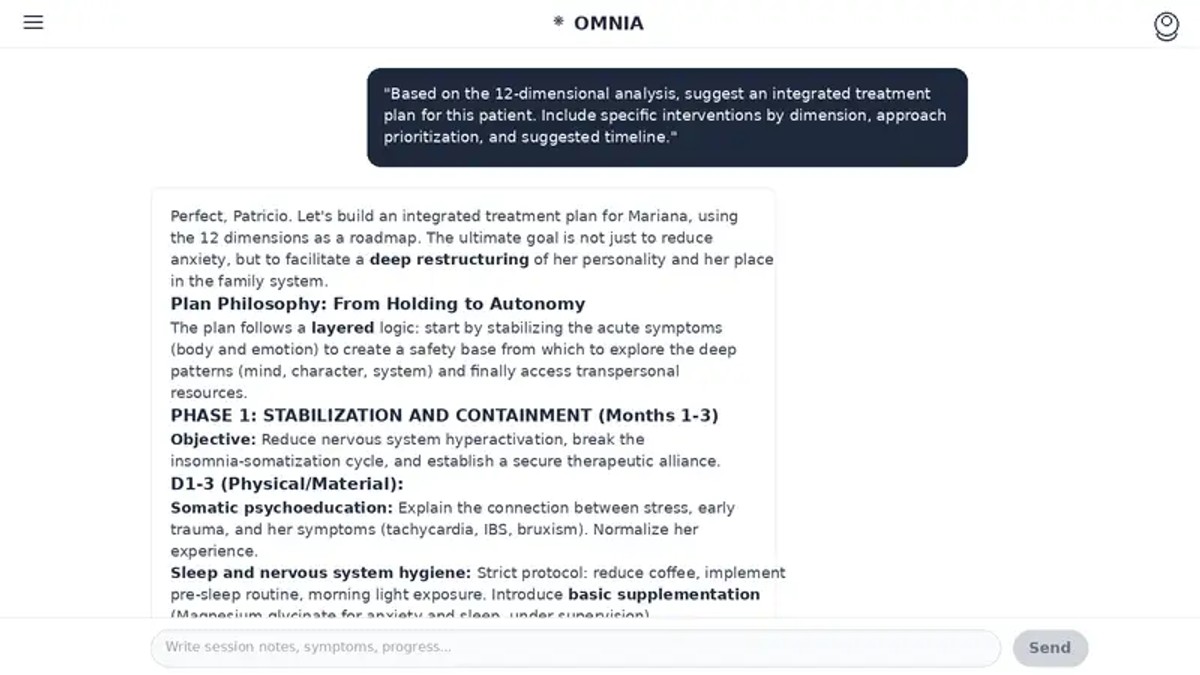
Phase 1: Stabilization and containment (months 1-3). Absolute priority on the physical (D1-3) and emotional (D6) dimensions. The goal is to reduce nervous system hyperactivation, break the insomnia-somatization cycle, and establish a secure therapeutic alliance. Interventions include somatic psychoeducation (explaining the connection between stress, trauma, and symptoms), a sleep hygiene protocol (reducing coffee, pre-sleep routine, morning light exposure), grounding exercises and diaphragmatic breathing, and teaching Mariana to identify and name emotions in the body. The reasoning is clear: without physiological stability, there is no safe access to deep material, a principle that research on the window of tolerance and autonomic nervous system regulation has consistently demonstrated (Porges, 2011).
Phase 2: Exploration and processing (months 4-9). Here the temporal (D4), personality (D8), systemic, and deep cognitive (D7) dimensions are addressed. Current reactions are connected with childhood survival strategies. The Enneagram is introduced as a self-knowledge map. The emotional genogram is created to visualize transgenerational patterns (Bowen, 1978). And core beliefs begin to be restructured: "I am only valuable if I am perfect" can be transformed into something more livable, a process that Young et al. (2003) systematized in their schema therapy.
Phase 3: Integration and new meanings (month 10 onward). The existential (D9) and transpersonal (D11) dimensions are addressed. The logotherapeutic questions arrive now: "Beyond being the strong and responsible one, who is Mariana?" (Frankl, 1946/2006). Contemplative practices are introduced and the differentiation between essence and personality is explored, between who she really is and the survival program she built.
What it did differently: Omnia does not just suggest what to do, but when and why in that order. A Jungian therapist might want to start with the dreams. A cognitive one with the beliefs. A systemic one with the genogram. The multidimensional analysis proposes a sequence that respects the biology of trauma (Herman, 1992; Porges, 2011): first the body, then the emotion, then the meaning. Not by hierarchy of value, but by therapeutic necessity.
The evolution: 6 weeks later
At 6 weeks, a follow-up report was entered into Omnia. Mariana showed significant improvement in sleep (now sleeping 6-7 hours), reduced tachycardia, but persistent irritability with her husband. And two new elements: she had discovered intense anger toward her mother that she did not know she had, and she reported a recurring dream where she was in a dark house searching for someone she could not find.
The question to Omnia was direct: What do these changes indicate from the multidimensional analysis? Which dimensions are responding and which require adjustment?
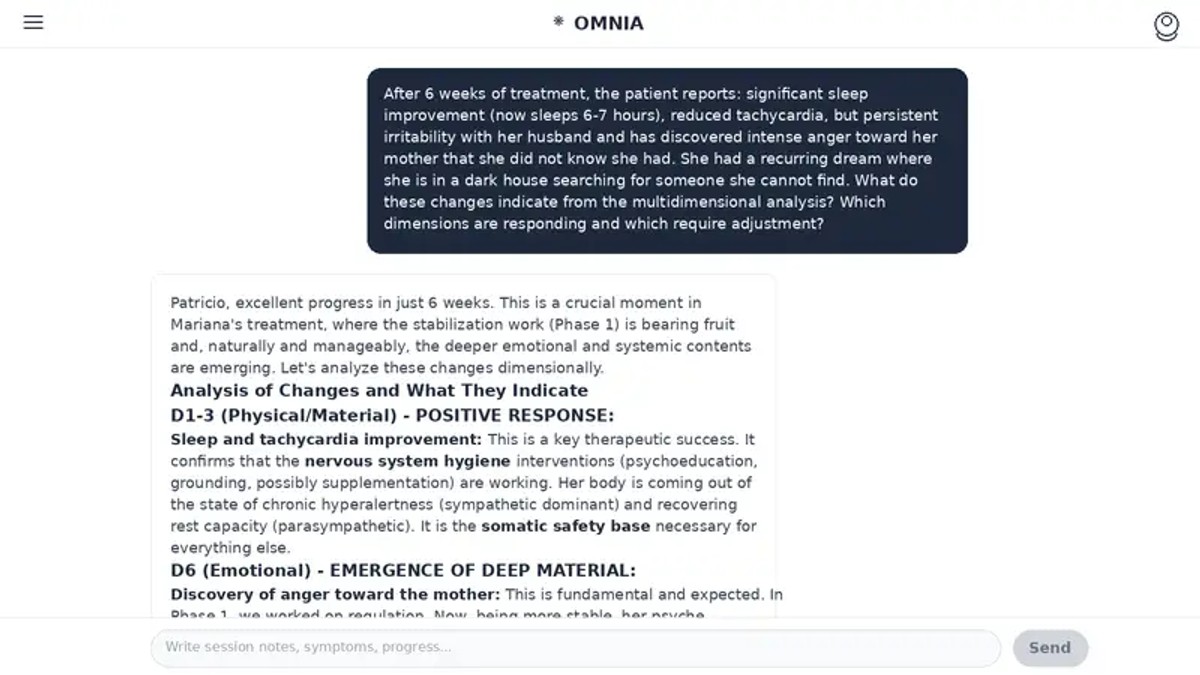
The response was precise and stratified.
In the physical dimension (D1-3), the improvement in sleep and tachycardia confirms that the stabilization interventions are working. The body is coming out of a state of chronic hyperalertness and recovering the capacity for rest. Omnia called it "the somatic safety base necessary for everything else," a concept aligned with Porges' (2011) polyvagal theory.
In the emotional dimension (D6), the emergence of anger toward the mother was analyzed as "fundamental and expected." Now more stable, her psyche allows her to access the core emotion that was beneath the anxiety: anger, the passion of Enneagram Type 1 (Naranjo, 1994). Before, that rage was unconscious and somatized as tension and bruxism. Now it is becoming conscious and available for processing. It is a sign of progress, not regression.
The persistence of irritability with her husband was reframed: it is no longer just generalized anxiety. It is transferred rage. Her husband, being "emotionally absent, like my mom," activates the same wound and the same emotion. Research on adult attachment confirms that partners tend to mutually activate internal working models formed in childhood (Mikulincer & Shaver, 2019), perpetuating early relational patterns.
And the dark house dream was analyzed from the unconscious/archetypal dimension (D10). The "dark house" as a representation of the unconscious, of the psyche, of the family history. "Searching for someone who cannot be found" as an image of the abandonment wound. Jung (1964) described dreams as the royal road to the collective unconscious, and this kind of archetypal imagery (the house, the search, the darkness) appears frequently at moments of psychic transition.
Omnia identified that the main defense mechanism (reaction formation) was weakening. Mariana no longer just "endures"; she feels the rage. This can generate guilt in an Enneagram Type 1 ("Is it wrong to feel this toward my mother?"), and she needs a therapeutic space where that emotion is legitimized as a natural response to childhood deprivation, not as a moral defect (Rogers, 1961).
The suggested adjustments were concrete: deepen D6 work with techniques like the empty chair (Perls et al., 1951) or unsent letters so she can express the rage in a safe space. Work the systemic dimension by addressing the repetition dynamic: "What would happen if, for one week, you experienced your husband as not being your mother? If you asked him for something specific without expecting him to guess?" And use the dream as a gateway to the unconscious through active imagination (Jung, 1968).
What it did differently: Omnia did not interpret the persistence of irritability as "treatment failure." It reframed it as evolution: the treatment allowed the real cause beneath the symptom to emerge. And it adjusted the plan accordingly, shifting the focus from D1-3 (now stabilized) to D6, D10, and the systemic dimension.
What no single approach could see
Let us recap what the multidimensional analysis revealed that would have taken months, or years, to reach with a single approach.
The connection between Enneagram Type 1 and somatization. The Reformer's repressed anger does not disappear: it freezes into muscle tension, bruxism, irritable bowel (Naranjo, 1994). Without mapping the character structure, a therapist could treat the physical symptoms without understanding the mechanism generating them.
The exact transgenerational repetition of the caregiver role. Mariana did not just learn to be the responsible one: she is replicating it with surgical precision in her current family. And her son is already absorbing the pattern. Research confirms that parental anxiety patterns are transmitted intergenerationally (Trepiak et al., 2022; Bie et al., 2024). An exclusively individual approach would not see this transmission in progress.
The dream as messenger from the unconscious. The dark house and the search for someone who does not appear is first-order clinical material (Jung, 1964) that a cognitive-behavioral approach would probably not explore, yet it contains keys to the deep resolution of the case.
The anger as the core emotion beneath the anxiety. What Mariana presents as anxiety is, in its deepest architecture, contained rage. This is consistent with both the Enneagram reading (Riso & Hudson, 1999) and the psychoanalytic theory of defense mechanisms (Freud, 1926/1959). Without accessing that emotional layer, treatment stays on the surface.
The correct therapeutic sequence. Starting with cognitive restructuring is not the same as starting with somatic stabilization. Herman's (1992) triphasic model and Porges' (2011) polyvagal theory hold that physiological safety is a prerequisite for deep emotional processing. The multidimensional analysis tells you not just what to address, but in what order and why.
And the intergenerational transmission in real time. Mariana's anxiety is not just her problem. It is a pattern already passing to her 9-year-old son. Intervening in Mariana means intervening in the entire system (Bowen, 1978).
No single approach is to blame for not seeing all of this. Each was designed to illuminate certain dimensions with depth. The problem is not the tool. It is the limitation of the field of vision.
Your training is not incomplete. Your field of vision can be expanded
If you are a CBT therapist, your work with beliefs and automatic thoughts is valuable (Beck, 1976; Bhattacharya et al., 2023). If you are a Gestalt therapist, your ability to connect with bodily and emotional experience is irreplaceable (Perls et al., 1951; Calvet et al., 2025). If you are a systemic therapist, your reading of family patterns has a depth that no other approach matches (Bowen, 1978; Von Sydow, 2024). The same applies if you work from Jung, Frankl, Ellis, Rogers, or Freud.
Multidimensional analysis does not invalidate any of that. It completes it. It allows you to see, from the very first session, dimensions that your training did not prioritize but that may be exactly what is keeping a case stuck.
Mariana would not improve by just restructuring thoughts. Or by just exploring her unconscious. Or by just doing a genogram. She would improve with an approach that sees all 12 dimensions simultaneously and proposes a logical sequence of intervention that respects the complexity of the human being.
That is what Omnia does. It does not diagnose for you. It does not prescribe treatment. It widens your field of vision so you can make better clinical decisions with better information.
Better information produces better hypotheses. Better hypotheses produce better interventions. Better interventions produce better outcomes.
The next time you have an anxiety case that will not resolve, it may not be your technique. It may be a dimension you are not seeing.
Try Omnia free: 100 consultations, no credit card required →
References
Bartholomew, K., & Horowitz, L. M. (1991). Attachment styles among young adults: A test of a four-category model. Journal of Personality and Social Psychology, 61(2), 226–244. https://doi.org/10.1037/0022-3514.61.2.226
Beck, A. T. (1976). Cognitive therapy and the emotional disorders. International Universities Press.
Bhattacharya, S., Goicoechea, C., Heshmati, S., Carpenter, J. K., & Hofmann, S. G. (2023). Efficacy of cognitive behavioral therapy for anxiety-related disorders: A meta-analysis of recent literature. Current Psychiatry Reports, 25(1), 19–30. https://doi.org/10.1007/s11920-022-01402-8
Bie, F., Yan, X., Xing, J., Wang, L., Xu, Y., Wang, G., Wang, Q., Guo, J., Qiao, J., & Rao, Z. (2024). Rising global burden of anxiety disorders among adolescents and young adults: Trends, risk factors, and the impact of socioeconomic disparities and COVID-19 from 1990 to 2021. Frontiers in Psychiatry, 15, 1489427. https://doi.org/10.3389/fpsyt.2024.1489427
Bowen, M. (1978). Family therapy in clinical practice. Jason Aronson.
Bowlby, J. (1982). Attachment and loss: Vol. 1. Attachment (2nd ed.). Basic Books. (Original work published 1969)
Calatrava, M., Riso, D. D., & Pérez-Testor, C. (2022). Differentiation of self: A scoping review of Bowen Family Systems Theory. Clinical Psychology Review, 91, 102112. https://doi.org/10.1016/j.cpr.2021.102112
Calvet, B., Vallejo, J.-L., Plu, Y., Soulat, I., Foucher, A., & Clément, J.-P. (2025). Use of the Temperament and Character Inventory to describe the effectiveness of Gestalt therapy. Frontiers in Psychiatry, 16, 1280954. https://doi.org/10.3389/fpsyt.2025.1280954
Clark, D. A., & Beck, A. T. (2010). Cognitive therapy of anxiety disorders: Science and practice. Guilford Press.
David, D., Cotet, C., Matu, S., Mogoase, C., & Stefan, S. (2018). 50 years of rational-emotive and cognitive-behavioral therapy: A systematic review and meta-analysis. Journal of Clinical Psychology, 74(3), 304–318. https://doi.org/10.1002/jclp.22514
Diadiningrum, J. R., & Yudiarso, A. (2022). Logotherapy is effective in increasing self-esteem, but caution is needed: A meta-analytic study. MEDIAPSI, 8(2), 95–102.
Elliott, R., Bohart, A. C., Watson, J. C., & Murphy, D. (2021). Therapist empathy and client outcome: An updated meta-analysis. Psychotherapy, 58(4), 431–443. https://doi.org/10.1037/pst0000356
Ellis, A. (1962). Reason and emotion in psychotherapy. Lyle Stuart.
Frankl, V. E. (2006). Man's search for meaning. Beacon Press. (Original work published 1946)
Freud, S. (1959). Inhibitions, symptoms and anxiety. W. W. Norton. (Original work published 1926)
Herman, J. L. (1992). Trauma and recovery: The aftermath of violence—from domestic abuse to political terror. Basic Books.
Jung, C. G. (1964). Man and his symbols. Doubleday.
Jung, C. G. (1968). The archetypes and the collective unconscious (2nd ed.). Princeton University Press.
Kaisler, R. E., Fede, M., Diltsch, T., Probst, T., & Schaffler, Y. (2023). Common mental disorders in Gestalt therapy treatment: A multiple case study comparing patients with moderate and low integrated personality structures. Frontiers in Psychology, 14, 1304726. https://doi.org/10.3389/fpsyg.2023.1304726
King, A., Turner, M. J., Mayber, R., Sherlock, L., Sherlock, E., & Wood, A. G. (2024). A systematic review of the nature and efficacy of Rational Emotive Behaviour Therapy interventions. PLOS ONE, 19(7), e0305652. https://doi.org/10.1371/journal.pone.0305652
Li, J., Wang, X., & Zhang, Y. (2025). Trends in the epidemiology of anxiety disorders from 1990 to 2021: A global, regional, and national analysis with a focus on the sociodemographic index. Journal of Affective Disorders, 371, 118–127. https://doi.org/10.1016/j.jad.2024.12.043
Mikulincer, M., & Shaver, P. R. (2019). Attachment in adulthood: Structure, dynamics, and change (2nd ed.). Guilford Press.
Minuchin, S. (1974). Families and family therapy. Harvard University Press.
Narayan, A. J., Lieberman, A. F., & Masten, A. S. (2022). Intergenerational transmission and prevention of adverse childhood experiences (ACEs). Clinical Psychology Review, 85, 101997. https://doi.org/10.1016/j.cpr.2021.101997
Naranjo, C. (1994). Character and neurosis: An integrative view. Gateways/IDHHB.
Perls, F., Hefferline, R., & Goodman, P. (1951). Gestalt therapy: Excitement and growth in the human personality. Julian Press.
Porges, S. W. (2011). The polyvagal theory: Neurophysiological foundations of emotions, attachment, communication, and self-regulation. W. W. Norton.
Ramos-Vera, C., Barrientos, A., Baños-Chaparro, J., Saldarriaga, L., & Saintila, J. (2022). Enneagram typologies and healthy personality to psychosocial stress: A network approach. Frontiers in Psychology, 13, 1051271. https://doi.org/10.3389/fpsyg.2022.1051271
Riso, D. R., & Hudson, R. (1999). The wisdom of the Enneagram: The complete guide to psychological and spiritual growth for the nine personality types. Bantam Books.
Rogers, C. R. (1959). A theory of therapy, personality, and interpersonal relationships, as developed in the client-centered framework. In S. Koch (Ed.), Psychology: A study of a science. Vol. 3 (pp. 184–256). McGraw-Hill.
Rogers, C. R. (1961). On becoming a person: A therapist's view of psychotherapy. Houghton Mifflin.
Santomauro, D. F., Mantilla Herrera, A. M., Shadid, J., Zheng, P., Ashbaugh, C., Pigott, D. M., ... & Ferrari, A. J. (2021). Global prevalence and burden of depressive and anxiety disorders in 204 countries and territories in 2020 due to the COVID-19 pandemic. The Lancet, 398(10312), 1700–1712. https://doi.org/10.1016/S0140-6736(21)02143-7
Scharfe, E., Pitman, R., & Bhela, S. (2023). Toward a causal link between attachment styles and mental health during the COVID-19 pandemic. British Journal of Clinical Psychology, 63(1), 95–108. https://doi.org/10.1111/bjc.12441
Stein, M. (2006). Jung's map of the soul: An introduction. Open Court.
Trepiak, P., Trepiak, T., Guérin-Marion, C., Kristen, A., & Deneault, A.-A. (2022). A systematic review and meta-analysis of the associations between father and child anxiety and depression. Psychology of Men & Masculinities, 24(1), 17–32. https://doi.org/10.1037/men0000413
Von Sydow, K. (2024). Systemic psychotherapy: An introduction to its theoretical foundations and practice. Frontiers in Psychology, 15, 1399781. https://doi.org/10.3389/fpsyg.2024.1399781
World Health Organization. (2025, September 8). Anxiety disorders. https://www.who.int/news-room/fact-sheets/detail/anxiety-disorders
Yang, X., Fang, Y., & Chen, H. (2021). Global, regional and national burden of anxiety disorders from 1990 to 2019: Results from the Global Burden of Disease Study 2019. Epidemiology and Psychiatric Sciences, 30, e36. https://doi.org/10.1017/S2045796021000275
Yin, Z., Chen, J., & Liu, X. (2025). CBT treatment delivery formats for generalized anxiety disorder: A systematic review and network meta-analysis of randomized controlled trials. Translational Psychiatry, 15, 214. https://doi.org/10.1038/s41398-025-03414-3
Young, J. E., Klosko, J. S., & Weishaar, M. E. (2003). Schema therapy: A practitioner's guide. Guilford Press.

About Patricio Espinoza
Psicoterapeuta integrativo fundador de Omnia